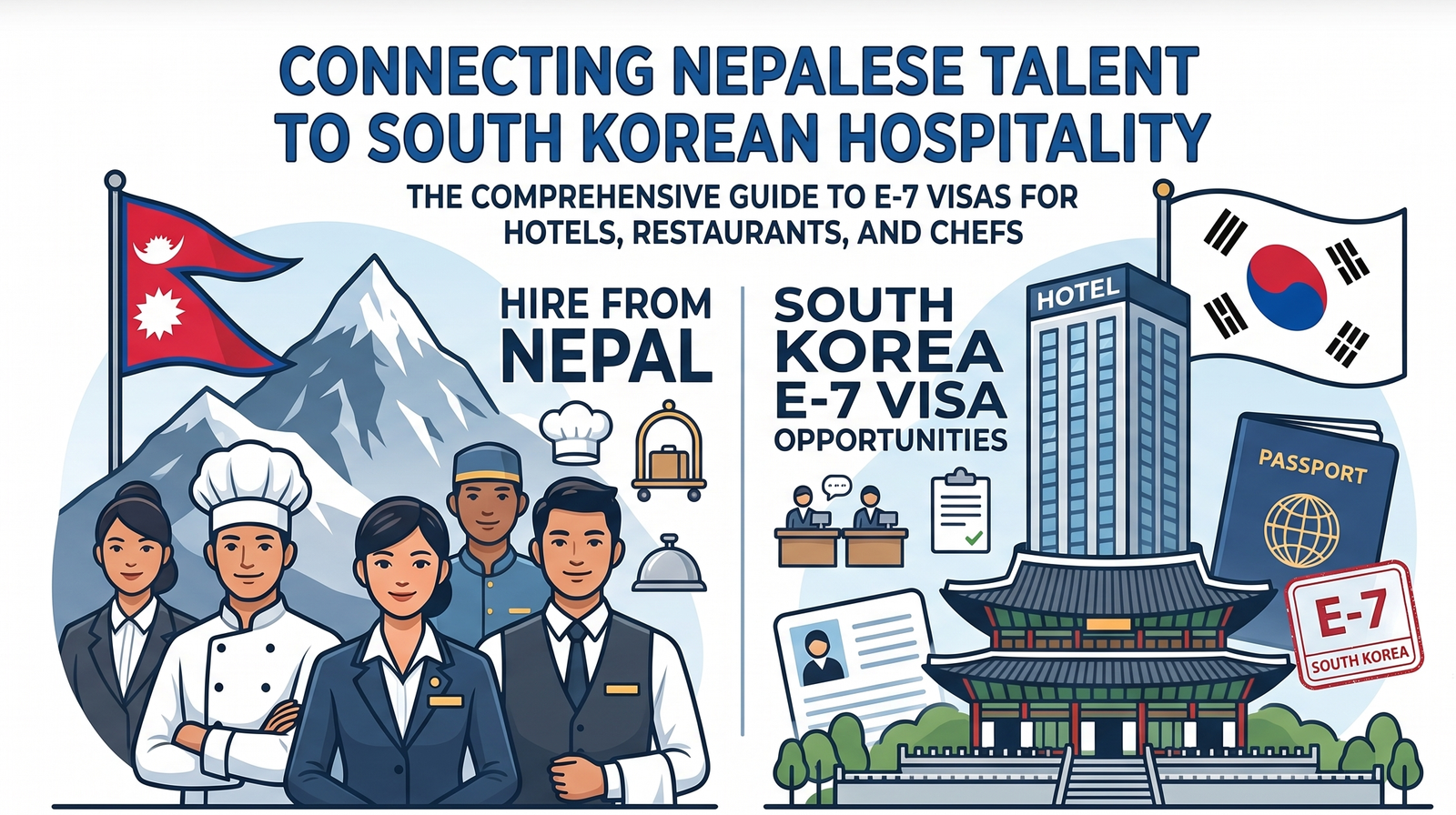
The Comprehensive Guide to Hiring Nepalese Hospitality Workers for South Korea on E-7 Visas
Introduction: A New Gateway for Global Talent
The South Korean hospitality industry is experiencing a dynamic resurgence. As tourism numbers climb back to and exceed pre-pandemic levels, hotels, resorts, and premium dining establishments across Seoul, Busan, Jeju, and beyond face a critical challenge: a severe shortage of skilled, service-oriented professionals. Enter a groundbreaking policy shift: the Government of Nepal has officially authorized licensed manpower recruitment agencies to send skilled workers to South Korea under the E-7 specific occupation visa.
This monumental decision bridges the gap between Korea’s soaring demand for top-tier hospitality talent and Nepal’s rich supply of globally experienced service professionals. For South Korean hoteliers and restaurateurs, the ability to directly hire hospitality workers from Nepal via regulated agencies is a game-changer. This comprehensive guide details everything you need to know to leverage this new pipeline, from navigating E-7 visa requirements to successfully onboarding your new staff.
Why Hire Hospitality Workers from Nepal?
Nepal is recognized globally as a premier source of hospitality talent. For decades, Nepalese workers have been the backbone of the luxury hospitality sector in the Middle East, the Maldives, Malaysia, and international cruise lines. By partnering with the best recruitment agency in Nepal to recruit hotel workers from Nepal, Korean employers gain several distinct competitive advantages:
- World-Class Experience: Many Nepalese candidates come with years of experience working for elite international brands such as Marriott, Hilton, Hyatt, and Ritz-Carlton. They are already trained in international luxury standards.
- Exceptional Service Disposition: Nepalese culture places a profound emphasis on hospitality. This cultural bedrock translates into a naturally warm, patient, and highly attentive service style that perfectly aligns with Korea’s exacting customer service expectations.
- Language Proficiency: English is widely taught in Nepal, and professionals in the hospitality sector possess excellent English communication skills. This is invaluable for Korean hotels catering to an international tourist base.
- Adaptability and Resilience: Known for their strong work ethic and adaptability, Nepalese workers integrate smoothly into fast-paced, high-pressure environments like commercial kitchens and busy hotel front desks.
Demystifying the E-7 Visa for Hospitality
The E-7 (Specific Occupation) visa is South Korea’s designated visa class for foreign nationals possessing specialized skills and knowledge. Unlike the E-9 visa, which targets non-professional manual labor, the E-7 is designed strictly for professionals and semi-professionals.
The Ministry of Justice oversees 86 designated job categories under the E-7 visa. When looking to hire chefs and cooks from Nepal or source hotel receptionists, employers must target specific sub-categories and job codes:
1. Professional Level (E-7-1)
This category is for high-level management and specialized experts. Minimum salary requirement: 31.12 million KRW per year.
- Manager in Accommodation, Travel, or Sports (Job Code: 1521): Ideal for Hotel General Managers, Rooms Division Managers, or Front Office Managers.
- Food Service Manager (Job Code: 1522): Suitable for Restaurant General Managers or Food & Beverage Directors.
2. Semi-Professional Level (E-7-2)
This category encompasses the core operational staff required in hospitality. Minimum salary requirement: 25.89 million KRW per year.
- Hotel Receptionist (Job Code: 3922): Front desk agents, guest relations officers, and concierges.
- Chef and Cook (Job Code: 441): Executive chefs, sous chefs, pastry chefs, and specialized line cooks (e.g., Western, Indian, or Halal cuisine specialists).
- Tourism Interpretation Guide (Job Code: 43213): Multilingual guides assisting foreign tourists.
Strict Employer Requirements: Are You Eligible?
The South Korean government protects the domestic labor market by enforcing strict requirements on companies wishing to sponsor E-7 visas. Before you consult with the best manpower agencies in Nepal, you must ensure your business understands the costs and fees associated with international hiring and meets the following criteria:
- Minimum Domestic Workforce: Your company must employ a minimum of five (5) Korean nationals. These employees must be registered on the company’s employment insurance subscriber list for at least three consecutive months and must be paid at or above the national minimum wage.
- The 20% Rule: To prevent over-reliance on foreign labor, the number of E-7 visa holders in your company generally cannot exceed 20% of your total Korean national workforce.
- Financial Viability and Tax Compliance: The employer must prove financial stability. Most importantly, the company must have zero arrears in national and local taxes.
- Wage Guarantees: You must formally contract to pay the E-7 visa holder the minimum required salary for their specific visa tier as dictated by current official Korean immigration notices.
Candidate Qualifications: Who Can Be Sponsored?
Just as employers are heavily vetted, the Nepalese candidates must prove they possess the specialized skills the E-7 visa demands. Navigating this is much easier when utilizing a proper legal guide to hiring. A candidate must meet one of the following three core baseline requirements to be eligible:
- The Master’s Path: A Master’s degree or higher in a field directly related to the occupation. Under this path, no prior work experience is legally required, though employers usually prefer it.
- The Bachelor’s Path: A Bachelor’s degree in a relevant field, plus at least one (1) year of verifiable work experience in that exact occupation following graduation.
- The Veteran Path (5-Year Rule): This is the most common and practical route when looking to hire chefs and cooks from Nepal. If a candidate does not possess a relevant university degree, they can still qualify by providing verifiable proof of five (5) years of continuous work experience in the specific occupation.
The End-to-End Recruitment Process
Now that the Nepal government permits licensed manpower agencies to process E-7 visas, the recruitment workflow has become significantly more secure. Here is the step-by-step process for Korean employers:
Step 1: Partnering with a Licensed Nepalese Agency
Engage a recruitment agency in Nepal that is officially registered with the Department of Foreign Employment (DoFE). A reputable agency will act as your on-the-ground HR partner, filtering thousands of applicants down to the elite few who meet Korea’s strict E-7 criteria.
Step 2: Issuing the Demand Letter
The Korean employer issues a formal Demand Letter, Power of Attorney, and Employment Contract to the Nepalese agency. These documents must often be attested by the local Chamber of Commerce in Korea and the Nepalese Embassy in Seoul.
Step 3: Sourcing, Screening, and Trade Testing
The agency advertises the positions and heavily pre-screens candidates for educational and experience requirements. The best agencies will facilitate live video interviews for you. For culinary roles, agencies can organize practical ‘Trade Tests’ in industrial kitchens.
Step 4: Document Verification (The Critical Phase)
The agency collects all necessary candidate documents: passports, academic transcripts, and most importantly, employment experience certificates. To avoid fatal recruitment mistakes, these documents must be rigorously verified, notarized, and often apostilled, as Korean immigration is highly strict regarding fraudulent experience claims.
Step 5: Visa Issuance Number (VIN) Application
With the candidate’s documents and your company’s corporate documents, your immigration lawyer or administrative agent in Korea applies for the Visa Issuance Number at the local Korean immigration office.
Step 6: Visa Stamping and Deployment
Once the VIN is issued, the candidate applies for the physical E-7 visa stamp at the Embassy of the Republic of Korea in Nepal or through the officially designated Korea Visa Application Center (KVAC) in Kathmandu. Following approval, the agency handles pre-departure orientation, ticketing, and deployment.
Conclusion: Securing the Future of Your Business
The hospitality industry is ultimately defined by the quality of its people. As South Korea’s demographic landscape shifts, sourcing local talent for demanding service and culinary roles will continue to be a challenge. The strategic decision to source talent globally offers a sustainable, high-quality solution.
By navigating the E-7 visa framework with the assistance of professional manpower agencies in Nepal and seasoned immigration experts in Korea, your hotel or restaurant can build a diverse, resilient, and deeply hospitable workforce ready to elevate your guest experience to global standards.
Hiring Nepali Workers by Country | 2026 Recruitment OutlookHiring Nepali Workers: 7 Vital Legal & Compliance Steps for 2026Manpower Supplying Agency of NepalHow to Hire Nepali Worker Online in 2026 | Complete Manpower Agency GuideHiring Nepali Workers by Country | 2026 Recruitment OutlookHow to Hire Nepali Worker Online in 2026 | Complete Manpower Agency Guide