Oman Work Visa for Nepali Workers — Complete Guide 2026
Oman Work Visa for Nepali Workers — Complete Guide 2026
Oman’s work visa process is managed by the Ministry of Labour and the Royal Oman Police (immigration). Oman ties work permits to specific occupations — changing a worker’s role requires a new permit. This guide covers every visa type, the complete document checklist, processing timeline, fees, and Oman-specific requirements.
For the full hiring process, see our Oman Employer Guide. For verified agency contacts, visit the main contact directory.
Oman Work Visa Categories
| Visa Type | Sponsor | Duration | Key Feature |
|---|---|---|---|
| Employment Visa (Private Sector) | Private company | 2 years, renewable | Occupation-specific; tied to employer |
| Project Visa | Project owner | Project duration | For specific projects; non-transferable |
| Investor/Partner Visa | Self-sponsored | 2 years, renewable | For business owners with CR and capital |
| Temporary Work Visa | Employer | 3–6 months | Short-term assignments; limited renewal |
Employment Visa — Step-by-Step Process
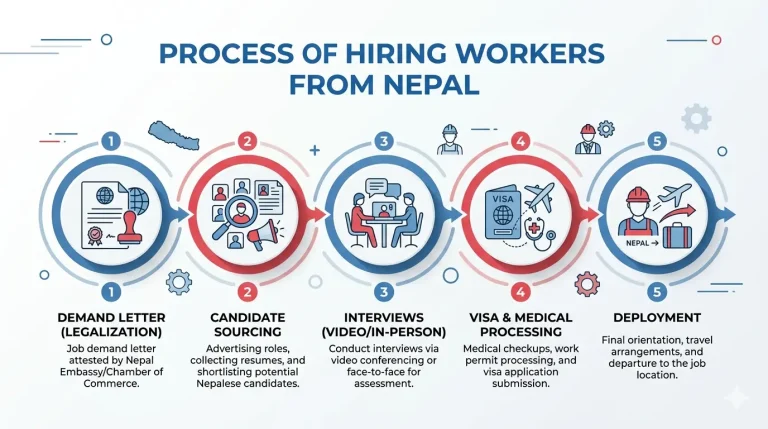
- Ministry of Labour Clearance (Days 1–10). Employer submits manpower requirement through the Ministry’s e-services portal. Required: valid CR, establishment card, proof of Omanization compliance. Ministry issues labor clearance.
- Demand Letter Attestation (Days 10–17). Attest through: Oman Chamber of Commerce and Industry → Ministry of Foreign Affairs → Nepal Embassy in Muscat. Our Demand Attestation guide covers the process.
- Document Dispatch to Nepal (Days 17–19). Send labor clearance, attested demand letter, and power of attorney to the agency in Nepal.
- Visa Stamping (Days 19–25). Agency submits documents to the Omani embassy/consulate covering Nepal for employment visa stamping.
- Worker Travel (Days 25–29). Worker travels to Oman with stamped passport.
- Post-Arrival (Days 29–40). Medical examination, Resident Card application, fingerprinting at Royal Oman Police.
Required Documents
Employer Documents
- Valid Commercial Registration (CR)
- Establishment card
- Ministry of Labour clearance (manpower approval)
- Attested demand letter
- Attested power of attorney
- Signed employment contract (bilingual English/Arabic)
- Proof of Omanization compliance
Worker Documents
- Valid passport (minimum 2 years validity)
- Passport-size photographs (white background)
- Educational/skill certificates (attested)
- Experience certificates
- GAMCA medical report
- Police clearance certificate
Visa Costs
| Cost Item | Approximate Amount (OMR) |
|---|---|
| Ministry of Labour clearance | 50–100 |
| Employment visa fee | 20–50 |
| Visa stamping fee | 10–20 |
| Medical examination (GAMCA + Oman) | 20–40 |
| Resident Card | 10–20 |
| Health insurance (basic) | 20–50/year |
Occupation-Specific Permits — What Employers Must Know
Unlike some GCC countries where a generic work visa covers multiple roles, Oman ties the employment visa to a specific occupation code. If you hire a worker as an electrician and later need them to work as a plumber, you must apply for a new labor clearance and visa with the correct occupation code. This is a common cause of compliance violations — ensure the occupation on the demand letter matches the actual work the employee will perform.
Common Rejection Reasons
- Omanization non-compliance. Companies not meeting sector-specific Omani employee quotas face labor clearance blocks.
- Occupation mismatch. The job title on the demand letter must match an approved Ministry occupation code.
- Incomplete attestation. Missing any stamp in the Chamber → MOFA → Nepal Embassy chain.
- CR/Establishment card issues. Expired or suspended commercial registration.