Hire Nepali Housemaids 2026: Legal Domestic Worker Recruitment
Hire Nepali Housemaids 2026: Legal Domestic Worker Recruitment
Hiring domestic staff across borders carries obligations that go beyond a standard employment contract — and doing it legally protects both the employer and the worker. Mount Everest International, a DOFE-licensed agency (licence 1481/074/75, 20+ years, 10,000+ placements), places Nepali housemaids and domestic helpers through the official channels of each destination: the UAE’s Tadbeer system, Saudi Arabia’s Musaned platform, and the licensed-agency routes of Qatar and Kuwait. For ethical, fully documented placements, contact +977 9801153854 (WhatsApp/Viber).
This 2026 guide covers domestic-worker salaries by country, the mandated processes per destination, the ethical-standards framework we operate under, the document checklist, and realistic timelines — domestic placements take longer than skilled trades, and that is by design.
Why Employers Choose Nepali Domestic Staff
- English + Hindi communication. Nepali housemaids typically manage household English for instructions and coordinate in Hindi with drivers, cooks and nannies from the wider household staff.
- Household experience. Candidates bring documented home-country experience in childcare, elder care, cooking and housekeeping, verified through reference calls.
- Trust profile.
- Nepali domestic workers consistently earn trust ratings from placement agencies and families for honesty and long-term stability — many households renew contracts across multiple terms.
- Ethical clarity. Our domestic placements run zero-fee-to-worker with POE orientation — households know their hire arrived without debt pressure, which correlates directly with better workplace relationships.
Because domestic work sits inside special regulatory tracks, always verify current rules before committing — see the country guides for UAE and Saudi Arabia.
Nepali Housemaid Salaries 2026 (By Country)
Domestic-worker salaries are set through official platforms in the UAE and Saudi, with agency-mediated contracts elsewhere. 2026 levels:
| Country | Monthly Salary | Process |
|---|---|---|
| UAE | AED 1,400 – 2,200 | Tadbeer licensed centres |
| Saudi Arabia | SAR 1,200 – 1,800 | Musaned platform |
| Qatar | QAR 1,400 – 2,000 | licensed agency + Qatar Visa Center |
| Kuwait | KWD 110 – 160 | licensed agency + domestic worker law |
Domestic packages include accommodation and food at the employer’s household, medical coverage, rest days per local law, and — in the UAE and Saudi systems — wage protection filed through the platform. Employers should treat any quote below these bands as a red flag: under-priced offers correlate with illegal fee-charging somewhere in the chain.
The Official Channels, Country by Country
UAE: Tadbeer
The UAE routes domestic hiring through licensed Tadbeer centres. The employer (or a registered recruitment agency) files the offer through the centre, which coordinates the worker’s visa, medical and Emirates ID. Our role on the Nepal side: sourcing, POE orientation and pre-departure documentation so the candidate arrives Tadbeer-compliant.
Saudi Arabia: Musaned
Saudi domestic hiring runs through the Musaned platform, which fixes service-fee ceilings, issues the contract, and tracks employer accreditation. Employers must hold an active Musanen-registered household approval; our Kathmandu processing aligns the worker file with the platform’s contract before visa issuance.
Qatar and Kuwait
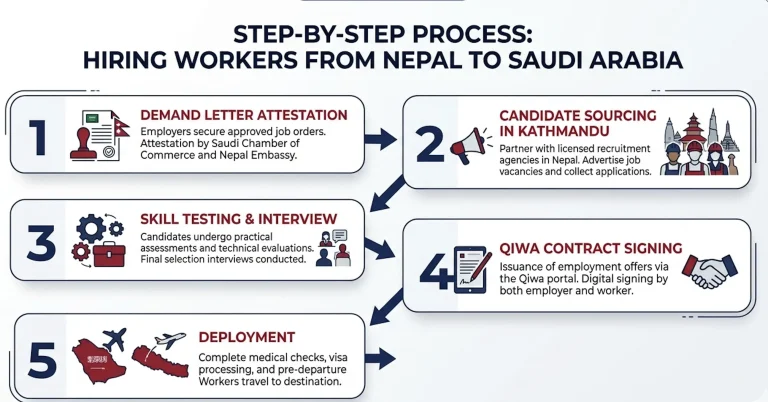
Qatar processes domestic workers through licensed agencies with the Qatar Visa Center medical; Kuwait applies its domestic-worker law with its own contract template. In both, the demand letter must pass attestation before any visa step — the same chain documented in our 10-step hiring process.
Ethical Recruitment Standards (Non-Negotiable)
Domestic work is where ethical failures hurt most — isolated workplaces make protections matter. Our domestic placements run on four fixed standards:
- Zero cost to the worker. The worker pays nothing — no fees, no “training costs”, no salary deductions for placement. All costs sit with the employer, consistent with Nepal’s Free Visa Free Ticket policy and the IOM’s IRIS standard for ethical recruitment. Our ethical recruitment policy applies in full.
- Pre-departure orientation (POE). Every domestic worker completes Nepal’s mandatory pre-departure orientation at the Kathmandu academy — covering rights, helplines, wage protection, rest days and the destination country’s rules.
- Rest-day and wage-protection clauses. Contracts state salary, rest days, medical coverage and the platform wage-protection mechanism in English and Nepali, signed before departure.
- Verification-first sourcing. Reference calls for childcare or elder-care claims; medical fitness including age-appropriate screening; and explicit candidate consent to the household type (family composition, other staff, pets) before matching.
One important rule for employers: Nepal’s regulations on female domestic-worker migration have changed repeatedly over the years and differ by destination and age band. Rules current today may differ from what a friend’s placement did last year. Our desk verifies the live rule with DOFE for every domestic letter before we accept it — treat any agency that says “no restrictions, quick visa” as a warning sign.
Document Checklist for Domestic Placements
| Document | Domestic-Specific Notes |
|---|---|
| Employer household approval | Tadbeer/Musaned registration or local equivalent |
| Attested demand letter | States household role, salary, accommodation terms |
| Standard domestic contract | Destination template, bilingual EN/NE |
| Candidate consent file | Household type, composition, duties — signed in Nepal |
| POE orientation certificate | Nepal’s mandatory pre-departure course |
| Police clearance + medical | Including destination-specific tests |
| DOFE pre-approval | Required before any visa sticker |
The consent file deserves emphasis: it documents that the candidate understood and agreed to the specific household before departure. It protects employers too — matched expectations are the single strongest predictor of a placement that lasts. The full framework is in the costs and fees guide and the salary tables in the Gulf & Europe salary guide.
Employer Cost and Timeline
All-in employer cost per domestic worker runs USD 1,700-2,500, with platform fees in the UAE and Saudi determined by the official tariff. Domestic placements take 60-90 days — longer than skilled trades — because POE orientation scheduling, platform processing and consent documentation add deliberate checkpoints. Plan renewals and replacements on that timeline; the households that struggle are almost always the ones that tried to shortcut it.
For Agencies: Domestic-Placement Partnerships
Partner agencies handling domestic demand receive our compliance-checked candidate files (consent documentation, POE scheduling, medical pre-screening) and current-rule briefings from our DOFE desk — the part of this trade that changes most often. Two practical notes: Tadbeer-centre processing varies by emirate (confirm the centre before filing), and Musaned household approvals queue fastest when filed with complete documentation the first time. Partnerships desk: +977 9801153854.
Household Matching: The Detail That Determines Placement Success
Domestic placements succeed or fail on matching, not on skills. A housemaid excellent with toddlers may struggle in an elder-care household, and vice versa. Our matching file covers:
- Household composition: number of family members, children’s ages, elderly care needs, other staff in the home.
- Duties clarity: cooking (which cuisines), cleaning scope, childcare vs elder-care emphasis, pet presence.
- Working pattern: live-in arrangements, rest days, expected daily schedule — all consented in writing before departure.
- Candidate preferences: experienced candidates articulate what households they thrive in; respecting this halves first-year turnover.
Employers who fill this in honestly get placements that last multi-year terms. The households that churn through staff are almost always the ones that skipped the matching file.
Wage Protection and Rest Days by Country (2026)
| Country | Wage Mechanism | Rest Day Standard |
|---|---|---|
| UAE (Tadbeer) | Platform-tracked salary payments | Weekly rest day per contract |
| Saudi (Musaned) | Platform contract with fixed salary | Per Musaned contract terms |
| Qatar | Contract-filed salary with licensed agency oversight | Weekly rest day per contract |
| Kuwait | Domestic worker law protections | Statutory rest day |
Salaries paid through platform mechanisms leave an audit trail that protects both sides — and any household offering to pay “cash off-platform” should expect compliant agencies to decline.
Employer Mistakes to Avoid in Domestic Hiring
- Skipping the consent file. A candidate surprised by the household is a placement at risk; consent documentation is the cheapest insurance in this trade.
- Believing “no restrictions” claims. Nepal’s female domestic-worker rules change; verify the live rule through a DOFE-licensed desk before committing to a start date.
- Under-quoting to win the match. Below-band offers correlate with fee-charging elsewhere in the chain — and with disputes later.
- Treating 60-90 days as a delay. The POE orientation, platform processing and consent checkpoints are exactly what make the placement durable; the shortcut version is how placements fail.
Replacement and Renewal Cycles: Planning for the Long Term
Domestic staffing works best when employers plan the renewal date from the start. Contracts typically run two years; the households with the best outcomes start the renewal conversation four months before expiry — discussing salary review, home-leave timing and any role changes while the worker still has runway to consider alternatives calmly. Rushed renewals in the final month are where pressure tactics creep in and placements unravel.
For replacements, the 60-90-day placement lead time shapes household planning: families anticipating a change (a term ending, a relocation, a household need shifting from childcare to elder-care) should open the process a full quarter ahead. We keep matched-candidate reserves for returning families — a replacement letter from a previous client moves to the front of the queue because the household file and consent documentation are already on record. Families that came through us once typically complete their second placement in 30-40 days instead of the full window.
One more long-term note: domestic workers on their second and third terms arrive with Gulf experience, platform wage-protection history and settled expectations — the most durable placements in the entire trade. Our desk tracks term history for every candidate and flags the experienced returnees for families that value stability over the marginal salary saving of a first-term hire.
The Orientation Difference: What POE Training Actually Covers
Nepal’s mandatory pre-departure orientation for domestic workers is not a formality — it is a genuine 39-hour curriculum (for domestic roles) run at accredited Kathmandu academies, and the strongest families we serve ask about it specifically. Modules cover destination-country labour law and the worker’s legal rights; wage protection and salary-record keeping; rest-day and working-hours standards; communication and cultural orientation; health, hygiene and kitchen-safety basics; helpline numbers and the Nepali embassy contact; and travel logistics from airport to arrival.
Employers feel the difference in the first month: workers who arrive POE-trained understand their contract terms, know their helpline, and settle into household routines faster because the orientation pre-answers the questions that otherwise surface as first-week anxiety. It is the clearest example of why the longer, compliant timeline produces better placements — every checkpoint in the 60-90-day window exists because it measurably improves what happens after arrival. Our desk schedules POE slots alongside the medical and visa steps so the timeline never stretches from idle waiting, only from verification.
Destination Deep Dive: Where Domestic Letters Go in 2026
| Corridor | System | 2026 Note |
|---|---|---|
| UAE | Tadbeer centres | Processing varies by emirate; confirm centre first |
| Saudi Arabia | Musaned platform | Complete household files clear fastest |
| Qatar | Licensed agency + QVC | Medical scheduling is the pacing item |
| Kuwait | Domestic worker law | Contract template fixed by law; consent file still applies |
One rule holds across all four corridors: the Nepal-side regulation layer (DOFE rules on female domestic-worker deployment, by destination and age band) sits on top of the destination’s system and changes most often. Every letter our desk accepts carries a fresh DOFE verification — the live rule on the day your file moves, not a cached assumption from a previous placement.
Communication Between Placements and Families
Our desk stays reachable for both sides through the placement term — families message about role changes, renewal timing or a question about a rest-day clause; workers use the same channel for anything they are not comfortable raising directly. That open channel is deliberately boring: most months it carries nothing but renewal scheduling, but when something matters it is the pressure valve that keeps small misunderstandings from becoming disputes. Families placing through us for the first time sometimes ask why the agency stays in the loop after departure — the answer is the term-completion data: placements with an active agency channel complete their contracts at visibly higher rates than fully hands-off placements, and that is the outcome everyone signed up for.
Frequently Asked Questions
How much does it cost to hire a Nepali housemaid in Dubai?
Salary runs AED 1,400-2,200 per month with accommodation and food provided; the employer’s all-in placement cost (Tadbeer fees, visa, medical, flight, processing) runs USD 1,700-2,500.
What is the legal process to hire a Nepali housemaid in Saudi Arabia?
File through the Musaned platform with an active household approval; the platform issues the contract and tracks the process. Our Kathmandu side prepares the worker’s file, POE orientation and documentation to match.
Does the housemaid pay any recruitment fee?
No. Our placements are zero-cost-to-worker: all recruitment, visa and travel costs sit with the employer, aligned with the Free Visa Free Ticket policy and IOM IRIS standards.
Can Nepal send female domestic workers to every Gulf country?
Not always. Nepal’s rules on female domestic-worker migration differ by destination and age band and have changed several times — our desk verifies the live rule with DOFE for every letter before accepting it.
How long does a domestic placement from Nepal take?
60-90 days from an attested demand letter — the extra checkpoints (POE orientation, platform processing, consent documentation) are what make the placement safe and durable.
Do returning families get faster placements?
Yes — households placing through us before keep their household file and consent documentation on record, so replacement letters move to the front of the queue and typically complete in 30-40 days.
Can we hire a housemaid who cooks Nepali food?
Yes — cooking-capable candidates are a standard match criterion; state the cuisine expectation in the household file.
What if the placement does not work out?
Compliant channels include platform-mediated resolution and, where necessary, replacement under the letter’s remedy clause — the consent file and clear contract terms make resolution straightforward.
Start a Legal, Ethical Domestic Placement
Send your household requirement — role, destination, family composition and start window — to +977 9801153854 (WhatsApp/Viber). Verify DOFE licence 1481/074/75 on the official registry, and review our ethical recruitment policy and the 2026 agency profile before you begin.