How to Hire Nepali Workers for Saudi Arabia
The Complete Employer's Guide: How to Hire Nepali Workers for Saudi Arabia
The Definitive 2026 Resource for Saudi HR Managers & Employers on Recruiting Nepali Manpower — Compliant, Ethical, and Cost-Effective
Published by Best Recruitment Hub | Updated March 2026 | 3,000-word Guide
If your company needs to hire Nepali workers for Saudi Arabia in 2026, this guide is your single authoritative reference. From understanding the January 2026 Nepal-Saudi Bilateral Labour Accord to navigating the Qiwa platform, demand letter attestation, and ethical recruitment standards — everything you need is here.
1. The 2026 Legal Landscape: A New Era of Recruitment
The recruitment of Nepali workers for Saudi Arabia underwent a fundamental transformation in January 2026 when both governments signed a landmark Nepal-Saudi Arabia Bilateral Labour Agreement (BLA). This accord represents the most comprehensive reform of the Nepal-KSA labour corridor in over two decades and directly impacts every employer seeking Nepali manpower.
The January 2026 Nepal-Saudi Bilateral Labour Accord
The 2026 BLA was crafted in direct response to International Labour Organization (ILO) pressure and years of documented worker complaints about "double contracts" — a fraudulent practice where workers were promised one salary in Nepal but presented with a different, lower contract upon arrival in Saudi Arabia. The accord established three pillars:
- Unified Contract System: A single, bilingual (Nepali/Arabic) employment contract must be signed in Nepal and digitally registered with both the Nepal Department of Foreign Employment (DOFE) and Saudi Arabia's Qiwa platform before the worker departs.
- Wage Protection Mechanism: Salaries must be deposited via the Mudad Wage Protection System (WPS) by the 10th of each calendar month, with automatic alerts sent to DOFE Nepal for any violations.
- Grievance Channel: A bilateral helpline and digital portal now allows Nepali workers to file complaints accessible by both Nepal's Foreign Employment Board and the Saudi Ministry of Human Resources.
Key Employer Benefit
Employers who comply with BLA terms gain access to a priority processing track at the Saudi Embassy in Kathmandu — reducing visa stamping time from 30 days to an average of 12 business days.
Zero-Cost Policy: What It Means for Your Company
Per ILO Recruitment Principles and the BLA's Schedule III, Saudi employers are now strongly encouraged — and in some government contract sectors, mandated — to adopt the Zero-Cost recruitment model. Under Zero-Cost:
- The employer or their licensed recruitment agency in Kathmandu covers all visa fees.
- The employer covers the worker's round-trip airfare (or at minimum the inbound ticket).
- No service fees are charged to the worker in Nepal — eliminating debt bondage risk entirely.
Companies adopting Zero-Cost practices report up to 35% higher worker retention rates in the first contract year, according to 2025 GCC HR Benchmarking data, making it a sound commercial decision beyond its ethical merits.
2. Why Hire Nepali Workers in 2026?
Nepali workers have become the preferred workforce for Saudi Arabia's construction, hospitality, and infrastructure sectors — and with good reason. Here is what consistently makes them the top choice for Saudi HR managers:
Discipline & Work Ethic
Independent GCC employer surveys consistently rank Nepali workers as among the most disciplined and punctual in the region. Their background — often from rural, hill-community environments that reward hard physical work and strong community loyalty — translates directly into low absenteeism rates and a strong culture of completing assigned tasks without supervision.
English Language Proficiency
Nepal's government education system mandates English-medium instruction from Grade 1, producing a labour force with foundational English comprehension that is measurably higher than comparable sending countries such as Bangladesh or Ethiopia. For multinational site supervisors or client-facing hospitality roles, this is a decisive advantage.
Proven GCC Track Record
With over 500,000 Nepali workers currently employed in Saudi Arabia alone, employers benefit from a mature social infrastructure — experienced community leaders, established Nepal Embassy support networks in Riyadh and Jeddah, and workers who arrive with peer-knowledge of Saudi workplace culture.
Professional Accreditation Programs (SVP) in 2026
A major 2026 development is the expansion of Nepal's Skills Verification Program (SVP), jointly administered by CTEVT Nepal and the GCC Standardization Organization (GSO). Skilled trade workers (electricians, welders, HVAC technicians, heavy equipment operators) can now hold internationally recognized digital certificates accessible via QR code — allowing Saudi employers to verify skills before deployment rather than after arrival on site.
Competitive Edge
Requesting SVP-certified candidates from your licensed manpower agency in Kathmandu gives you a workforce whose technical competency is independently verified — reducing training costs and on-site accidents.
3. 2026 Minimum Wage Structure by Job Category
The following table reflects the 2026 minimum wage standards established under the Nepal-Saudi BLA Schedule II. These are floor figures; employers in premium sectors (e.g., luxury hospitality, oil & gas) typically offer 15–25% above these minimums to attract higher-caliber candidates.
| Category | Example Roles | Basic Salary (SAR) | Food Allowance (SAR) | Total Minimum (SAR) |
|---|---|---|---|---|
| Unskilled | Cleaner, Helper, Labourer | 1,000 | 300 | 1,300 SAR |
| Semi-Skilled | Mason, Carpenter, Tile Fixer | 1,200 – 1,400 | 300 | 1,500 – 1,700 SAR |
| Skilled | Electrician, Welder, AC Mechanic | 1,500 – 1,800 | 300 | 1,800 – 2,100 SAR |
| Highly Skilled | Heavy Driver, Supervisor | 2,000 – 2,500 | 300 | 2,300 – 2,800 SAR |
| Professional | Engineer, IT Specialist | 5,000+ | 500+ | 5,500+ SAR |
All wages above must be paid through the Mudad Wage Protection System. Non-compliance triggers automatic fines. See the detailed cost and fees breakdown here for a full employer cost analysis including accommodation, medical, and insurance.
4. Essential Document Checklist for Demand Letter Attestation
Demand Letter Attestation is the first — and most critical — administrative step in the Saudi Arabia recruitment process from Nepal. Errors or omissions at this stage cause the majority of recruitment delays. Your documents must be attested in Saudi Arabia first, then forwarded to the Nepal Embassy.
- Demand Letter: On official company letterhead, specifying job category, headcount, the 2026 minimum wage (Standard: 1,000 SAR basic + 300 SAR food for unskilled), contract duration, working hours, and accommodation type. Attested by: (1) Saudi Chamber of Commerce, (2) Saudi Ministry of Foreign Affairs, (3) Nepal Embassy in Riyadh or Jeddah.
- Power of Attorney (POA): Authorizing your chosen licensed Kathmandu recruitment agency to act on your behalf in Nepal. Must name the agency's DOFE license number explicitly.
- Interparty Agreement: The formal contract between your Saudi company and the Nepal recruitment agency, detailing responsibilities, replacement guarantees, and fee structures.
- Electronic Authorization (E-Wakala): Issued via the Saudi Enjaz online platform, linked to the specific agency's DOFE license number. This digital authorization is checked by Nepal's DOFE before approving any worker deployment.
- Company Commercial Registration (CR): A certified copy of your Saudi business licence, required for embassy attestation.
- Employer Declaration of Compliance: A new 2026 requirement — a signed declaration confirming adherence to BLA wage terms, zero passport confiscation, and non-substitution of contracts.
Pro Tip
Use our complete Demand Attestation Guide for Nepal for country-specific attestation routing instructions and current Saudi Embassy in Kathmandu processing times.
5. Step-by-Step Recruitment Workflow
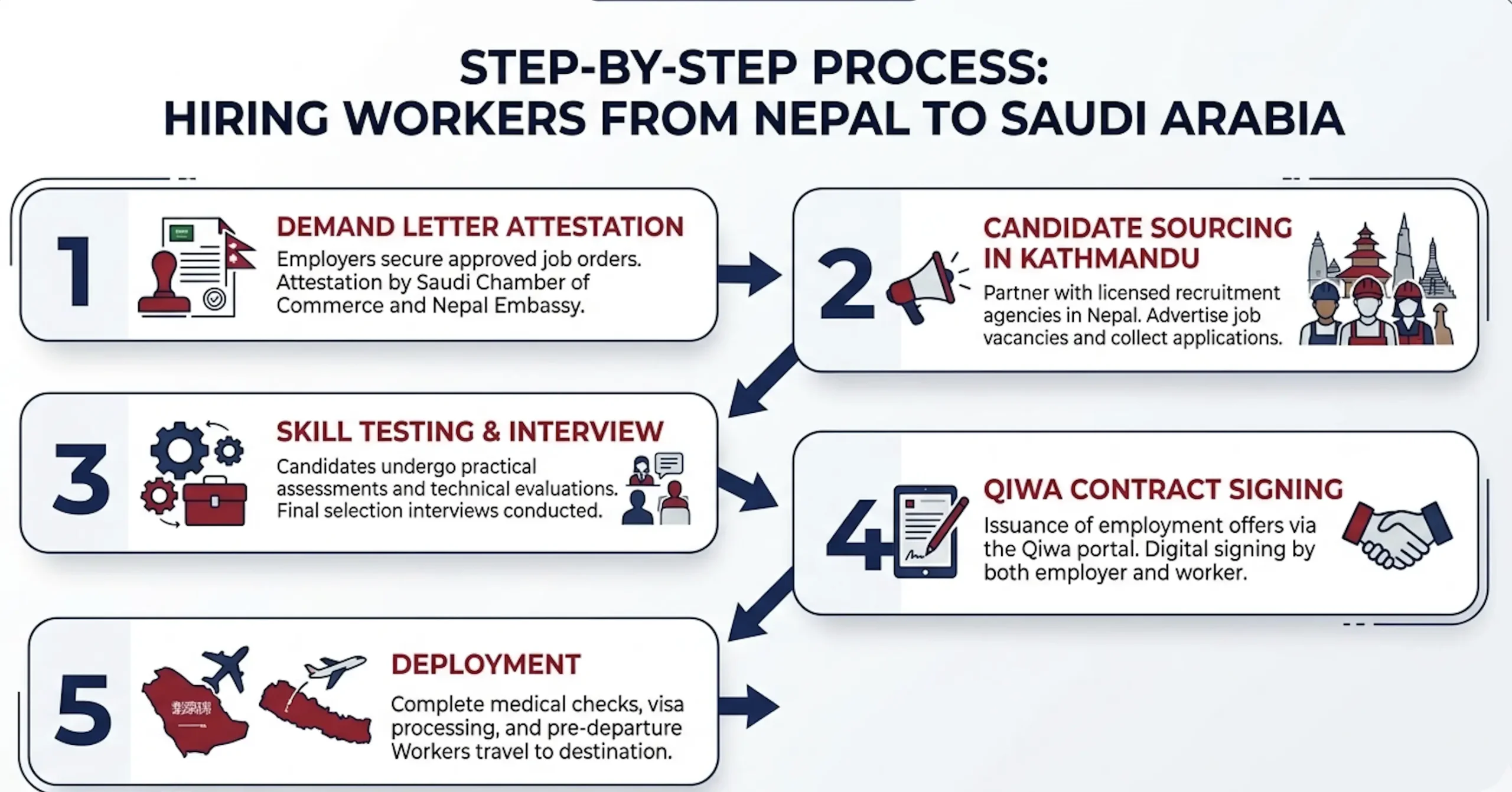
The following workflow reflects the 2026 standard recruitment process for deploying Nepali workers to Saudi Arabia, incorporating all new BLA requirements. Typical end-to-end timeline: 45–75 days from demand attestation to worker arrival.
Prepare all documents. Attest your Demand Letter via Saudi Chamber of Commerce → Saudi MOFA → Nepal Embassy in Riyadh or Jeddah. Issue E-Wakala via Enjaz to your chosen agency's DOFE license number. Timeline: 7–14 days.
Your licensed Kathmandu agency submits attested documents to Nepal's Department of Foreign Employment (DOFE). DOFE issues a Labour Permit (Kaam Garne Anumati) — the official Nepali government approval for worker deployment. Timeline: 5–10 days.
The agency advertises, screens candidates, and conducts trade tests. For skilled categories, candidates must hold or pass 2026 SVP-standardized skill certification tests recognized by CTEVT Nepal and the GSO. Employers may send a representative or use agency-managed video interviews.
All selected candidates undergo full medical fitness exams at GAMCA-approved clinics in Nepal (Kathmandu, Pokhara, Dharan, Chitwan). Results are electronically transmitted. Biometric data is registered with the Saudi embassy. A medical failure at this stage triggers agency-managed replacement — confirm your agency's replacement guarantee terms upfront.
The employment contract is signed in Nepal in the presence of DOFE representatives. Per 2026 BLA requirements, the contract is simultaneously uploaded to Saudi Arabia's Qiwa platform. A contract not registered on Qiwa is legally unenforceable. The worker receives a digital contract copy via mobile SMS.
The agency submits passport and medical clearance documents to the Saudi Embassy. With E-Wakala and Qiwa registration confirmed, stamping averages 10–15 business days (7–12 days for BLA-compliant employers on the priority track).
A mandatory 2-day PDO course conducted by DOFE-accredited trainers covers: Saudi labour law, worker rights under the BLA, cultural norms, emergency contacts, and how to use the worker grievance portal. Attendance is recorded — departure is blocked without a PDO completion certificate.
Workers obtain a Labour Approval Sticker from DOFE's Tribhuvan Airport desk on departure day. Your Saudi PRO should arrange airport pickup and site/accommodation induction within 24 hours of arrival. All workers must receive their Iqama (residency permit) within 90 days of arrival — this is now a trackable KPI under the BLA monitoring dashboard.
For a more detailed version of each stage, refer to our step-by-step process guide and the Employer Checklist for Nepal Recruitment Agencies.
6. Qiwa & Mudad: The Technical Backbone of 2026 Compliance
Two Saudi government platforms are now central to the legal employment of Nepali workers — and both are non-negotiable for 2026 compliance.
Qiwa: The Contract & Workforce Management Platform
Qiwa (operated by Saudi Arabia's Ministry of Human Resources and Social Development) is the mandatory digital platform for all employment contracts. In 2026, every employment contract for a Nepali worker must be digitally registered on Qiwa before the worker departs Nepal. Key Qiwa functions for employers:
- Contract issuance and renewal in Arabic and the worker's native language.
- Real-time workforce headcount management, including Saudization (Nitaqat) ratio tracking.
- Worker transfer and work permit renewal requests.
- Exit and re-entry (Khuruj) permit applications — now fully digital.
Mudad Wage Protection System (WPS)
Mudad is Saudi Arabia's Wage Protection System, which requires all employers to process salaries through registered bank accounts, with disbursement records automatically verified against Qiwa contract data. For Nepali workers, this means:
- Salaries must be disbursed by the 10th of each month.
- Any salary that falls below the Qiwa-registered amount triggers an automatic compliance flag.
- DOFE Nepal receives monthly automated salary confirmation data for all deployed Nepali workers — a 2026 BLA requirement that gives Nepal's government unprecedented real-time oversight.
- Employers who fail Mudad compliance for two consecutive months face visa quota suspension — meaning they cannot bring in new workers from any country until resolved.
Action Item for HR Teams
Ensure your payroll department is enrolled on Mudad before your first Nepali worker arrives. The Mudad registration process takes 3–7 business days and requires your company's Qiwa account to be active.
7. Saudization (Nitaqat) & Saudi Vision 2030 Labour Reforms
Saudi Vision 2030's workforce nationalization program — known as Saudization or Nitaqat — establishes mandatory quotas for Saudi nationals across all business sectors. Understanding current Nitaqat thresholds is essential before calculating how many Nepali (or other expatriate) workers you can legally hire.
2026 Nitaqat Thresholds Affecting Nepali Recruitment
- Engineering Sector: 30–46% Saudi national staffing required (up from 25% in 2024).
- Retail Sector: Specific sub-categories (gold/jewellery, eyewear, furniture) now require 100% Saudi national sales staff.
- Hospitality: Certain front-of-house hospitality roles in luxury properties now require up to 100% Saudi staffing in Riyadh, Mecca, and Madinah governorates.
- Construction & General Labour: Remains the largest unrestricted quota for Nepali workers. No Saudization minimum applies to unskilled/semi-skilled general labour roles.
- Domestic Work: Domestic workers (housemaids, drivers, cooks) fall under a separate regulatory framework and are not subject to standard Nitaqat calculations.
Companies classified in the Platinum or Green Nitaqat band receive preferential visa issuance and can apply for larger Nepali worker quotas. Maintaining compliance with Nitaqat is therefore a direct commercial lever — not merely a regulatory obligation. For a comprehensive breakdown by sector, visit our complete Saudi Recruitment Guide.
8. Ethical Recruitment & Zero-Cost Hiring: The Multinational Standard
For multinational corporations operating in Saudi Arabia — particularly those with ESG reporting obligations, listed company status, or contracts with international development institutions — ethical recruitment is no longer optional. It is a supplier due-diligence requirement enforced by buyers from the US, EU, and UK under their respective Modern Slavery Acts.
The Five Pillars of Ethical Recruitment from Nepal
No fee of any kind should be charged to the worker in Nepal. This includes agency fees, document processing fees, medical fees, orientation fees, or "deposits." The employer and agency absorb all costs.
The contract signed in Nepal must be identical to the contract presented in Saudi Arabia. The Qiwa registration requirement and DOFE Nepal oversight now provide a technological enforcement layer for this commitment.
Workers must be able to leave their accommodation freely during off-hours. Confining workers to labour camps except during working hours is a violation of Saudi Labour Law and ILO Convention C143.
See the Compliance section below. Passport confiscation is illegal, and fines were significantly increased in 2026.
Workers must be informed of their rights and given access to the Saudi MHRSD hotline, the Nepal Embassy in Riyadh/Jeddah, and the bilateral BLA grievance portal — in Nepali language — within 72 hours of arrival.
Companies wishing to formally demonstrate their ethical recruitment credentials can seek certification from IRIS (International Recruitment Integrity System), a globally recognized standard that is increasingly required in Saudi supply chain audits.
9. 2026 Compliance: Fines, Passport Confiscation Laws & Worker Rights
Confiscating a worker's passport is illegal under Saudi Labour Law Article 40 and was a common violation in previous years. Effective January 2026, under the BLA compliance enforcement schedule, the fine for passport confiscation has been raised to SAR 3,000 per passport held — and repeat violations now trigger visa quota suspension. HR managers must ensure all site supervisors and accommodation managers are trained on this regulation.
Key 2026 Compliance Benchmarks
- Iqama Issuance: Every Nepali worker must have a valid Iqama (residency permit) within 90 days of arrival. Delays expose the employer to daily fines and cannot be transferred to the worker.
- Contract Non-Substitution: Presenting a worker with a different contract upon arrival in Saudi Arabia is prosecutable under the Anti-Trafficking in Persons Law. Penalties include company blacklisting from all GCC labour markets.
- Exit Permit (Khuruj) Rights: Under 2021 Saudi reforms (still in force and reinforced by the 2026 BLA), workers do not require employer permission to exit Saudi Arabia for final departure. Annual leave exit permits can be applied for by the worker directly via the Absher platform.
- Rest Day Compliance: Workers are entitled to one rest day per week (typically Friday). Construction sector employers must maintain signed rest day records accessible to labour inspectors.
- Heat Work Restrictions: Outdoor work is prohibited between 12:00 PM and 3:00 PM from June 15 to September 15. Violations carry fines of up to SAR 10,000 per incident.
For a full cost and penalty matrix, see the 2026 Costs & Fees of Hiring Nepali Workers page.
10. Choosing a Licensed Manpower Agency in Kathmandu
The quality of your recruitment outcome depends substantially on your agency partner in Nepal. A licensed, reputable manpower agency in Kathmandu is not merely an administrative intermediary — they are your boots-on-the-ground HR team managing sourcing, trade testing, documentation, and pre-departure compliance.
Mandatory Agency Requirements (2026)
- Valid DOFE Institutional License (verify at the DOFE Nepal online registry).
- Registered on the Enjaz system with an active Saudi E-Wakala acceptance capability.
- GAMCA-network access for medical coordination.
- In-house or partnered CTEVT/SVP trade testing facility for skilled worker categories.
- Documented replacement guarantee policy — typically 90-day free replacement for medical failures and skill mismatches.
Questions to Ask Before Signing an Agency Agreement
- What is your average deployment-to-arrival timeline for Saudi Arabia in the past 12 months?
- Do you offer SVP-certified candidates for skilled trades?
- What is your worker replacement rate, and what does your replacement guarantee cover?
- Are you currently compliant with the Nepal-Saudi BLA Zero-Cost requirements?
- Can you provide three Saudi client references from the past 24 months?
Browse our vetted list of the best manpower agencies in Nepal or learn how to identify the best agency to hire Nepali workers for your sector.
📎 Related Guides & Resources
11. FAQ: Saudi Arabia Nepali Recruitment in 2026
A medical failure at a GAMCA-approved clinic in Nepal means the candidate is unfit for deployment to Saudi Arabia for the duration of their medical file (typically 3 months before re-examination is allowed). Common causes include active TB, Hepatitis B/C antigen-positive status, or uncontrolled hypertension.
For employers: your agency's replacement guarantee should cover medical failures at zero additional cost. Ensure this is explicitly written into your Interparty Agreement. The agency is responsible for sourcing a replacement candidate, running a new trade test, and re-submitting medical documentation — typically adding 15–25 days to the timeline.
For the failed candidate: they are not permanently blacklisted. After a waiting period and successful re-examination, they may apply for future deployment.
Under Saudi Arabia's 2021 labour reforms — now reinforced by the 2026 BLA — most expatriate workers, including Nepali workers, no longer require employer permission to exit Saudi Arabia for final departure at the end of their contract.
For annual leave exits, workers in most categories can apply directly via the Absher self-service portal or the Qiwa app, without requiring employer sign-off. However, some categories of domestic workers and certain Nitaqat-restricted roles may still require employer notification.
Employers should note: preventing a worker from leaving Saudi Arabia through passport confiscation, withholding exit papers, or issuing a travel ban without legal basis is a criminal offence. The 2026 BLA compliance mechanism gives Nepal's government direct visibility into such cases, and confirmed violations are escalated to Saudi MHRSD for prosecution.
Yes, but domestic worker recruitment operates under a separate regulatory framework from the general labour BLA. Domestic workers in Saudi Arabia are covered by the Domestic Workers Law (2013, amended 2021) rather than the Saudi Labour Law. Key differences: domestic workers are entitled to 9 hours of rest per day, 30 days paid annual leave, and one month's end-of-service gratuity per year.
The 2026 BLA includes a specific Annex on domestic workers establishing a minimum wage of 1,000 SAR/month for Nepali domestic workers in Saudi Arabia — a significant increase from previous unregulated norms. Domestic worker visas are processed through a separate Musaned platform channel.
Under standard 2026 conditions, the complete timeline from document preparation in Saudi Arabia to worker arrival in KSA averages 45 to 75 days:
Demand attestation (7–14 days) + DOFE pre-approval (5–10 days) + sourcing and trade testing (10–20 days) + medical and biometrics (5–10 days) + Qiwa registration and visa stamping (10–15 days) + PDO and departure (3–5 days).
Employers on the BLA Priority Track (Zero-Cost compliant) can reduce this to 35–50 days. Delays most commonly occur at the demand attestation stage (incomplete documents) and medical clearance stage (fitness failures requiring replacement candidates).
These are two distinct documents that serve different purposes and both are mandatory:
The Demand Letter is addressed to the Nepal Embassy and DOFE — it is the employer's formal request to recruit a specific number of workers in specific job categories at specified wages. It describes what workers will do, how much they will be paid, and under what conditions.
The Power of Attorney (POA) is a legal instrument that empowers a specific named recruitment agency in Kathmandu to act on the employer's behalf in Nepal — signing documents, submitting to DOFE, selecting candidates, and processing visas. Without a POA, the agency has no legal authority to represent you.
Based on aggregated case data from Nepal's DOFE and Saudi MHRSD, the most common employer mistakes are: (1) using an agency not registered on Enjaz, causing the E-Wakala to fail; (2) specifying wages below BLA minimums in the Demand Letter, triggering embassy rejection; (3) failing to include accommodation type and working hours in the Demand Letter, causing DOFE to return documents for amendment; (4) not registering contracts on Qiwa before worker departure, making the contract legally void upon arrival; (5) failing to issue Iqama within 90 days, resulting in accumulating fines. For a full list, read our guide on common recruitment mistakes when hiring Nepali workers.
Ready to Start Recruiting?
Connect with a DOFE-licensed, BLA-compliant recruitment agency in Kathmandu and get your 2026 hiring process started today.
Start Hiring Now Contact Our Team